Round 23 · Sat, Nov 14, 2026 · Simulation
A bouncing jelly blob
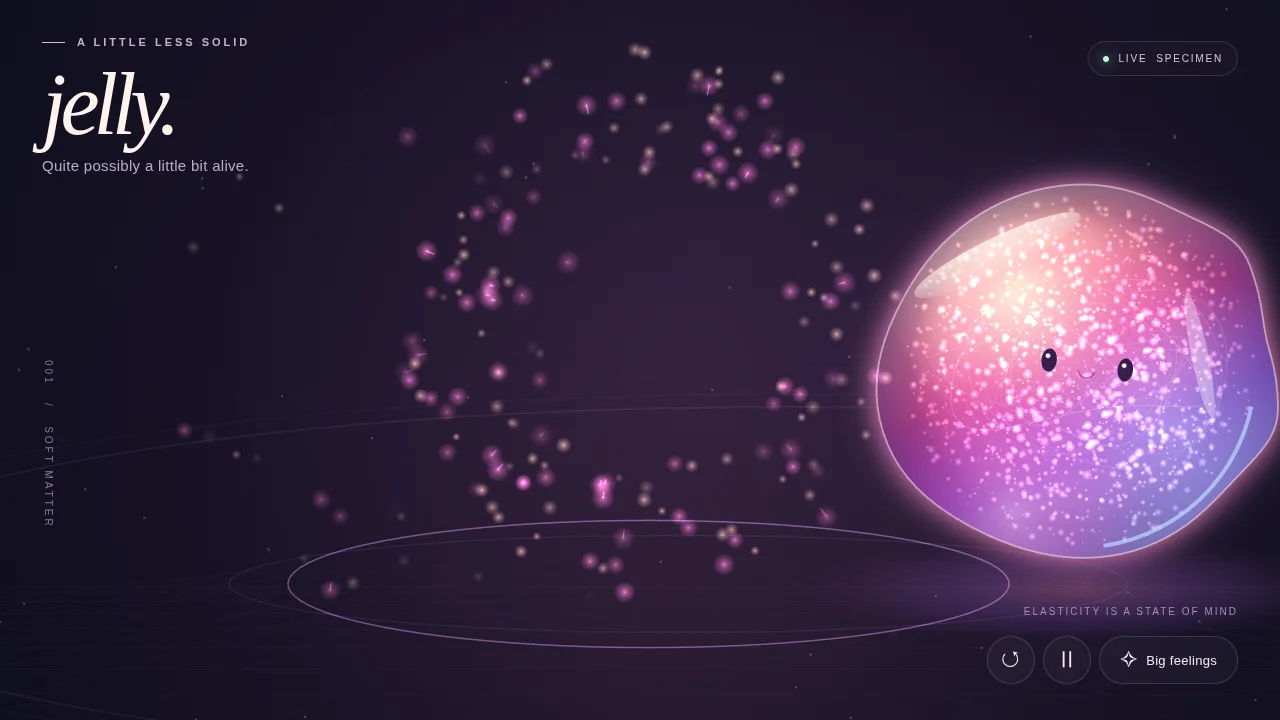
Same prompt, no human help: Claude Opus 5.5 and GPT-6 Astra each built a bouncing jelly blob as an interactive simulation.
Press Play on both, then drag or tap to stir them.
- Claude Opus 5.5AnthropicUnscored
Time: 16m 36sCost: $3.34
- GPT-6 AstraOpenAIUnscored
Time: 4m 52sCost: $0.94


Result: No winner
- Claude Opus 5.5Be one of the first to vote
- GPT-6 AstraBe one of the first to vote
Voting has closed: nobody voted, so there's no winner.
The battle video
Scoresheet
Recorded checks, build time, tokens and cost for each model
Scroll sideways to compare every model
| Measure | Claude Opus 5.5 | GPT-6 Astra |
|---|---|---|
| Result | Unscored | Unscored |
| Run | Completed | Completed |
| Task completion | Complete | Complete |
| Works? | Works | Works |
| Tests passed | 8/8 | 8/8 |
| Time | 16m 36s | 4m 52s |
| Cost | $3.34at list price | $0.94at list price |
| Tokens | 1,491,082 | 167,530 |
| Tool / harness | Claude Code | Codex CLI |
| Attempts | 1 | 1 |
How the cost is calculated
Estimated API cost: the tokens each model used × its provider's official list price per million tokens. Reasoning tokens are billed as output. Discounts and subscriptions are not included (these runs were paid for through subscriptions).
Scroll sideways to see every cost column
| Fresh input | 26 | × $4/M | $0.0001 |
|---|---|---|---|
| Cache reads | 1,261,492 | × $0.2/M | $0.25 |
| Cache writes (1 hour) | 124,971 | × $8/M | $1.00 |
| Output (incl. reasoning) | 104,593 | × $20/M | $2.09 |
| Fresh input | 31,589 | × $10/M | $0.32 |
|---|---|---|---|
| Cache reads | 125,952 | × $1/M | $0.13 |
| Output (incl. reasoning) | 9,989 | × $50/M | $0.50 |
Prices: platform.claude.com (checked 2026-10-10) · developers.openai.com (checked 2026-10-10)
Which result do you think is best?
The community vote decides this battle's result. Voting has closed: nobody voted, so there's no winner.
Watch the next battle and vote
Play it yourself
What each of the 2 models built, live in your browser

- Time
- 16m 36s
- Cost
- $3.34est.
- Tests
- 8/8
- Tokens
- 1,491,082
Passed 8 of 8 standard checks.
Run record
- Requested model
- claude-opus-5-5
- Resolved version
- claude-opus-5-5
- Tool / harness
- Claude Code 2.1.323
- Settings
- effort: high
- Attempts
- 1
- Human help
- None recorded
- Tool access
- Read, Write, Edit, ls, grep, wc, node --check
- Environment
- Linux server, a private empty folder (randomly named, not shared with the other model)
- Limits
- 30-minute timeout
- Input / output tokens
- 1,386,489 / 104,593
- Token details
- uncached_input: 26 · thinking_output: 70799 · cache_read_input: 1261492 · cache_creation_input: 124971 · cache_creation_1h_input: 124971 · cache_creation_5m_input: 0
- Cost basis
- Estimated
- Measurement notes
- Wall time measured by the daily worker (same method for both). Tokens from Claude Code's JSON result. Rules from the standard daily checks. Cost estimated from the recorded tokens × the provider's official list prices (checked 2026-10-10).
- Executed
- Nov 14, 2026, 3:00 AM GMT+9
- Time
- 4m 52s
- Cost
- $0.94est.
- Tests
- 8/8
- Tokens
- 167,530
Passed 8 of 8 standard checks.
Run record
- Requested model
- gpt-6-astra
- Resolved version
- Not available
- Tool / harness
- Codex CLI 0.167.0
- Settings
- reasoning_effort: high
- Attempts
- 1
- Human help
- None recorded
- Tool access
- Shell commands in a workspace-write sandbox (network off)
- Environment
- Linux server, a private empty folder (randomly named, not shared with the other model)
- Limits
- 30-minute timeout
- Input / output tokens
- 157,541 / 9,989
- Token details
- cached_input: 125952 · reasoning_output: 1654 · cache_write_input: 0
- Cost basis
- Estimated
- Measurement notes
- Wall time measured by the daily worker (same method for both). Tokens from codex exec --json (turn.completed usage). Rules from the standard daily checks. Cost estimated from the recorded tokens × the provider's official list prices (checked 2026-10-10).
- Executed
- Nov 14, 2026, 3:00 AM GMT+9
How the result is decided
This poll closed without enough votes for a result. Watch the next battle and vote.
- Claude Opus 5.58/8 checks
- GPT-6 Astra8/8 checks
The checks, time and cost are facts about each build, not a score. One observed run under stated conditions — not a universal ranking. How it works
The prompt
Every model received exactly this
Create a bouncing jelly blob: an interactive simulation that is fascinating to watch and even better to touch.

What makes it great:
- It feels physically believable: motion with weight, momentum and natural variation, driven by real (simplified) rules, such as forces, particles, cellular automata or fluid-like behaviour, not a canned animation.
- It is impressive from the very first frame, with no slow build-up from an empty screen, and it stays interesting with no input: when nobody has touched it for a few seconds it stirs itself (a gust, a ripple, a ghost hand), so someone who only watches still sees it at work.
- Touching it is satisfying: a drag or tap has an immediate, visible and physically sensible effect, and the system then settles or recovers on its own.
- It is rich and detailed: hundreds or thousands of elements where it suits the subject, while staying smooth.

How it is used:
- Drag and tap, with a mouse or a finger, to push, pour, stir, draw or attract, whatever suits the subject. Use Pointer Events so mouse and touch both work, and set touch-action: none on the canvas.
- A short hint on screen (for example "Drag to stir") that fades after the first interaction.
- Optional: a small, tidy panel of at most four controls (for example reset, pause and one or two sliders). It covers little of the simulation and fits a phone.

Make it astonishing. Both builds are shown side by side in a 30-second video on social media, where people decide in one second whether to stop scrolling:
- The very first frame is already striking: bold colour, light and motion, never an empty, plain or loading screen.
- Build to a signature moment within the first 10 seconds that makes people say "wow": a reveal, a transformation, an explosion of particles, a chain reaction.
- Go beyond the obvious version of the idea: choose a surprising, inventive take with its own world, mood and personality, not a generic template.
- Layer it: depth, glow and light, particles and trails, smooth easing, and detail that rewards both a glance and a closer look.
- It is watched at about half size on a phone: keep the important shapes big and high in contrast, and any key text large (at least 28 CSS pixels).
- Go big: thousands of glowing particles or a dense, colourful field, dramatic reactions to every touch, and a system that is mesmerizing even when nobody touches it.

Fixed rules (so every model is compared on the same terms):
- Exactly one file, index.html, in the current directory. Create no other files.
- Plain HTML, CSS and JavaScript. You may use three.js 0.170.0 from https://cdn.jsdelivr.net/npm/three@0.170.0/ (via an import map) if it helps. No other libraries, images, 3D models, fonts or network requests: build everything yourself in code (canvas, SVG, CSS or WebGL).
- It fills the browser window and works on a phone and on a desktop, with no page scrollbars.
- Animate with requestAnimationFrame and its timestamp so speed does not depend on the frame rate.

It must work in an ordinary browser on any graphics card. You cannot open a browser to look at it, so build it carefully:
- Every frame is fully drawn: no black, blank or flickering frames or patches. Keep any shader maths free of NaN and infinity (no division by a value that can reach zero, no pow() of a negative number, no normalize() of a zero-length vector), and clamp colours to a safe range before bloom or other post-processing.
- No errors in the browser console: if you use three.js, map "three" and "three/addons/" in the import map, and import everything you use.
- It runs smoothly on an ordinary laptop or phone: keep the pixel ratio at 2 or below, and avoid creating new objects every frame.
- It adapts when the window is resized or the phone is rotated.
- Do not hide errors: never wrap the main loop or whole functions in a try/catch that silently swallows them; fix the cause instead (a try/catch around storage or audio is fine).
- Step the simulation with a fixed or clamped time step, so a slow frame never makes it explode. Keep every value bounded (no NaN, no runaway speeds).
- It never dies out or freezes: it is still moving after minutes without input.
- Keep the cost steady: a fixed budget of particles or cells, and reuse arrays (typed arrays where useful) instead of allocating new ones every frame.

Before you finish, read your file once from top to bottom and make sure that:
- It moves on its own from the first frame.
- A mouse drag and a finger drag both visibly change it.
- It fits a 390×844 phone window and a 1280×720 desktop window.
- Nothing can throw an error in the browser console.

The battle video records about 30 seconds right after the page opens, with a mouse drag across the middle every few seconds.

Everything else is your choice: the rules, the look, colour, scale and detail. Make it as convincing, satisfying and spectacular as you can. Do not ask questions; make reasonable choices.
Run details: success criteria, conditions and notes
What counts as success
- Exactly one file, index.html, and no other files
- No libraries but three.js 0.170.0 (optional), and no images, models, fonts or requests
- Fills the window on a phone and a desktop, with no scrollbars
- Alive on its own from the first frame, driven by simulated rules
- Reacts to a mouse or finger drag and tap, with a hint on screen
- Stays stable and keeps moving without input
- Fully drawn on any graphics card: no black, blank or flickering frames or patches
- No errors in the browser console
Conditions
- Time limit
- 30 minutes
- Starting materials
- An empty, private folder for each model; neither can see the other's work
- Network access
- Blocked
- Tools
- Claude Code: Read, Write, Edit, plus ls, grep, wc and node --check (no browser, no Python), effort high. Codex CLI: codex exec in a workspace-write sandbox (any shell command, no browser, network off), reasoning effort high. Neither can open a browser to look at its result.
- Human assistance
- None. No edits after the prompt.
- Attempts
- One attempt each. A build that is missing, blank, erroring or not animating gets one fresh retry, disclosed on the entry. The editor may re-run a broken build (at most 3 attempts in all, or 4 when raising the time limit and keeping a partner that completed within the original limit), also disclosed with the reason.
- Other rules
- Both models start at the same moment, each in its own empty folder, with the identical prompt and no human help.
Notes
Time limit: 30 minutes. Prompt: AI Battle house template v3 (simulation); subject chosen by the editor.
Prompt fingerprint (SHA-256): ce7163094a6e35331676250dfdb63ac037071185f8f3adfa4f705d7672fa2bef
Corrections
- : Restore vertical video omitted by Kaggle download
More rounds
#25
A pendulum wave
· Simulation
- Claude Opus 5.5Unscored
- GPT-6 AstraUnscored
Result: No winner
Watch the next battle and vote
#30
A mood journal that paints your week
· Small application
- Claude Opus 5.5Unscored
- GPT-6 AstraUnscored
Result: Result pending
Be one of the first to vote
#29
A great wave in the style of a woodblock print
· Generative art
- Claude Opus 5.5Unscored
- GPT-6 AstraUnscored
Result: Result pending
Be one of the first to vote
Comments
Both models got the same prompt and a 30-minute limit. Claude Opus 5.5: passed 8/8 checks in 17 min (1 attempt); GPT-6 Astra: passed 8/8 checks in 5 min (1 attempt). Watch both and vote for the one you'd pick.
Start the conversation. Say which build you'd pick, and why.